Stackwiseスタックワイズ
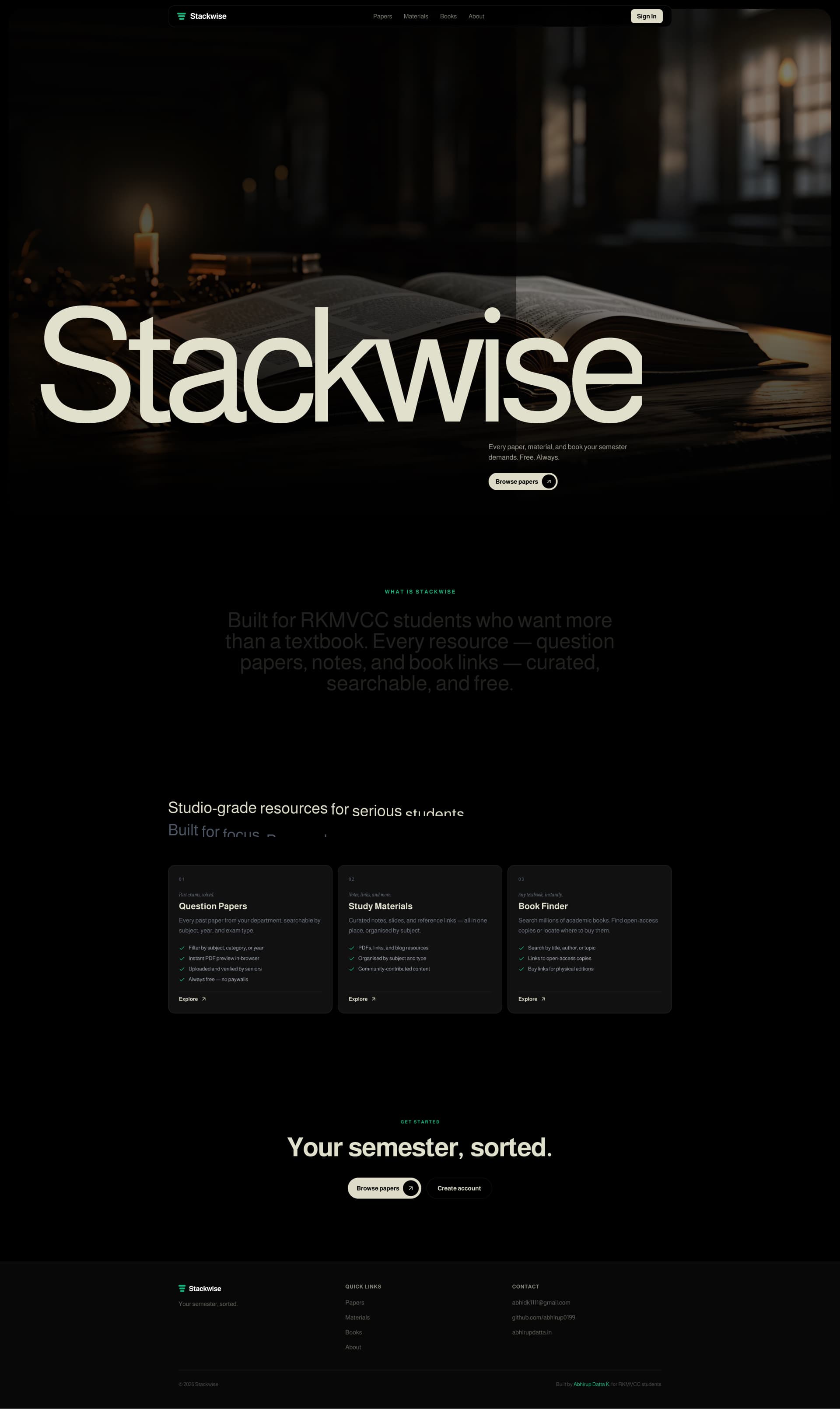
Every paper, material, and book your semester demands.
The
product
Stackwise is a free, searchable academic resource platform built exclusively for students at Ramakrishna Mission Vivekananda Centenary College. It brings together everything a student needs across a semester — past question papers, study materials, syllabi, class routines, and textbook discovery — in one place, with no login required to browse, no paywalls, and no ads. 247 question papers across 12 departments, searchable by subject, category, course code, exam type, and year. Community-contributed, community-maintained, built and run by one person. This isn't a product. There's no monetization, no growth target, no pitch deck. It's a community build — something I made because my college needed it and nobody else was going to.
What it fixes
Every student at RKMVCC has lived this: exam season arrives, you need past papers, and the search begins. WhatsApp groups. Asking seniors directly. Hoping someone saved a PDF somewhere. Finding a paper from 2019 but not 2021. Getting a file that won't open. Spending an hour on logistics that should take thirty seconds. The college doesn't maintain a centralized, student-accessible repository. Papers circulate informally — passed from batch to batch through personal contacts, shared in group chats, saved on individual drives. If you know the right person, you're fine. If you don't, you scramble. The invisible version of the problem is worse: things that get lost between batches. Papers nobody thought to save. Syllabi that change without notice. Routines posted on a notice board and never digitized. Books a professor recommended three years ago that no junior ever found. I lived this for three years. Stackwise is what I built so no junior has to.
The user
Stackwise has one user: the RKMVCC student. Specifically the one two days out from a mid-sem, searching for a 2022 CC-4 paper in Botany, and coming up empty everywhere else. The platform covers 12 subject areas — Computer Science, Physics, Mathematics, Microbiology, Zoology, Botany, Chemistry, AECC, GE, SEC, Value Education, and DSE — across both mid-sem and end-sem exam types, from 2017 to 2024. The filter system is built around exactly how a student searches: subject first, then category, then course code, then exam type, then year. Secondary users are seniors contributing materials — the community upload system is designed to be low-friction enough that contributing doesn't feel like a task.
What I did
Everything. Identified the gap from personal experience, sourced all 247 papers from the college database, converted them to PDFs, and uploaded them personally. Designed the full product in Figma, built the platform in Next.js, and maintain it ongoing. When a new paper needs to be added, I add it. When something breaks, I fix it.
Choices that shaped it
No login to browse
The single most important product decision. A student in exam panic does not have time to create an account before accessing a past paper. All five sections — Papers, Materials, Syllabus, Routines, Books — are fully open. Login exists only for community contribution (uploading) — not for consumption. This removes the only friction that would turn a useful tool into an abandoned one.
Video hero over static mockup
The homepage leads with a full-bleed background video — not an illustration, not a screenshot of the app. The visual choice communicates energy and seriousness before the user reads a word. The tagline that sits over it — "Every paper, material, and book your semester demands. Free. Always." — is as direct as the product itself.
Filter system built around student mental models
The Papers page filters by Subject, Category, Course Code, Exam Type, and Year — in that order of specificity. That's the order a student actually searches: subject first, then course code, then exam type. The filter order isn't alphabetical or technical — it mirrors real search behavior.
Paginated cleanly at 20
Dumping 247 links on one page would be unusable. The pagination shows 20 per page with clear prev/next controls and direct page number access. Each entry shows subject, category, course code, exam type, year, and a direct Open link — everything needed to decide if it's the right paper before clicking.
Book Finder as category search, not just text
The Books page leads with subject category chips alongside a text search. Students often don't know the exact title of a recommended book. Category browsing lets them discover it without knowing what they're looking for. Text search handles precision; chips handle exploration.
Five sections, not one
Papers was the starting point, but a semester is more than papers. Stackwise covers the full surface area of what a student needs: Materials for notes and references, Syllabus for knowing what's in scope, Routines for class schedules, Books for finding textbooks. Syllabus and Routines are placeholders for community-contributed content that will fill in over time.
Powered by the community
The upload system, the community contribution framing, the open browsing model — all of it is built to make Stackwise self-sustaining over time. I can't be the only person maintaining this forever. The product is designed so that seniors contributing before they graduate becomes the natural behavior.
Clean, calm visual language
Stackwise is used under pressure — exam week, limited time, specific need. The design is deliberately quiet: white backgrounds, clear typography, restrained color use, information-first layouts. The aesthetic is calm by design — the opposite of the anxiety the platform exists to reduce.
About page as accountability
A free community tool with no institutional backing needs a face. The About page names me, shows my photo, links my GitHub, LinkedIn, and portfolio, and states plainly: designed, developed, and maintained by one person. Students need to know there's a real person responsible for this, not an anonymous project that might disappear.
What's inside
- →Question Papers — 247 papers across 12 departments, filterable by subject, category, course code, exam type, and year (2017–2024)
- →Study Materials — curated notes, slides, and reference links organized by subject and type; community-contributed
- →Book Finder — textbook search by title, author, or topic with subject category shortcuts; links to open-access and purchase options
- →Community Upload — authenticated upload flow for seniors contributing papers, materials, syllabi, and routines
- →Syllabus — upload-ready; accepts community submissions (awaiting contributions)
- →Routines — class schedule section; upload-ready and accepts community submissions
- →Pagination — 20 papers per page across 13 pages with direct page number access
- ◇Expanded materials section — structured senior contribution flow before graduation
- ◇Cross-college template — fork-and-populate version for other institutions
Where it goes next
The immediate priority is filling in the Syllabus and Routines sections — the infrastructure exists, but the content needs to come from the community. Getting seniors to contribute before they graduate is the behavior the upload system is designed to encourage. Materials coverage is also uneven across departments — Computer Science is reasonably well-covered, but departments like Zoology and Microbiology have far fewer notes and references than their paper count suggests they should. Closing that gap is the next content priority. Longer term: Stackwise's infrastructure is college-agnostic. Only the data is RKMVCC-specific. A version that any student could fork and populate for their own institution would multiply the impact without requiring me to maintain everything centrally — and would turn a single community tool into something bigger.
What it taught me
I spent time going through the college database, pulling every paper I could find, converting them to PDFs one by one, and uploading them. It wasn't glamorous work. It was the kind of thing that takes hours and produces nothing visible until it's done — and then suddenly there are 247 papers in a searchable database that didn't exist before. Stackwise isn't the most technically complex project in my portfolio. It's not a hackathon win, not a design showcase, not a product with a roadmap and a Pro tier. It's a thing I built because I was tired of watching juniors go through the same friction I went through, and because I happened to have the data to fix it. That's the whole story. Sometimes that's enough.